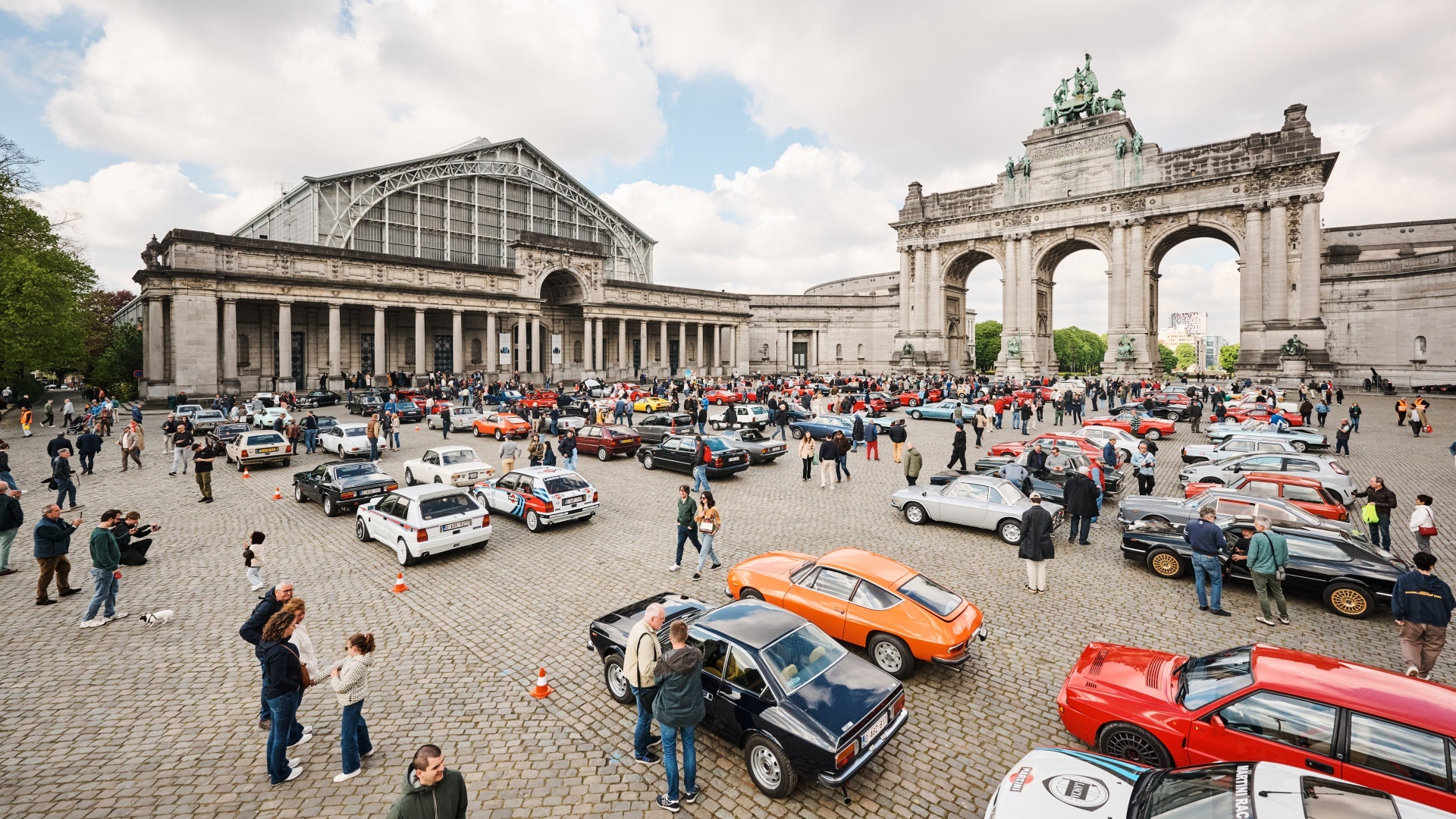
Autoworld Museum Brussels presents the pop-up exhibition 'Lancia 120 Years – innovation through Italian design', from Friday 27 February to Sunday 19 April 2026.
Through a carefully curated selection of around a dozen remarkable vehicles, the exhibition takes visitors on a journey through 120 years of Lancia, a brand renowned for its technical innovation, refined design, and rich motorsport heritage.

The exhibition is structured in two distinct sections. The first section, dedicated to design and innovation, highlights how Lancia consistently pushed boundaries with original shapes and forward-thinking technical solutions.
Among the vehicles on display are the Lancia Lambda (1924, 2nd series), an Astura featuring a special Pininfarina coachwork, the Aprilia, and the Aurelia B20.
In addition, two exceptional prototypes are presented: the Florida four-door (1956, chassis 005), a car rarely shown to the public outside the Brussels and Geneva motorshows and the Pininfarina PF200 from 1952.
And the impressive Lancia D50 from 1955, a revolutionary icon of Formula One.

The second section focuses on Lancia’s rally history, a chapter in which the brand became one of the most iconic names in international motorsport.
Models such as the Fulvia 1600 HF Fanalone, the legendary Stratos, and the Lancia 037 demonstrate how innovative technology and bold engineering kept Lancia at the very top of competition for many years.
The Delta Integrale, a symbol of rally dominance and still a beloved classic among enthusiasts today, represents one of the highlights of this section.
The exhibition has been made possible thanks to the Stellantis Heritage Hub, the MAUTO museum and the many private collectors who have generously loaned their vehicles.

Lancia D50 1955 – The F1 that changed the rules
First presented in 1954 and competing in 1955, the Lancia D50 marked a spectacular breakthrough in Formula 1 history. Designed by engineer Vittorio Jano, already famous for his creations at Alfa Romeo, this single-seater embodied Lancia’s ambition to challenge the world’s top teams.
Its architecture was revolutionary for the time: the 2.5-liter V8 engine was mounted at an angle to lower the center of gravity, while the fuel tanks were integrated into two distinctive side pontoons, improving the car’s balance as fuel was consumed. This bold design allowed for exceptionally efficient weight distribution.
Driven notably by Italian champion Alberto Ascari, the D50 immediately demonstrated its Grand Prix potential. Despite Lancia’s withdrawal from competition in 1955 for financial reasons, the car continued its career under Ferrari, evolving into the famous Ferrari D50.

Lancia PF200 1952 – The Avant-Garde of Italian Design
First presented in 1952, the Lancia PF200 is an exceptional prototype designed by Pininfarina on the Lancia Aurelia chassis. This car embodies the boldness and innovation that defined Italian design in the 1950s, with a fluid and balanced silhouette, generous glass surfaces, and lines of futuristic elegance for the era.
The PF200 concept stands out for its focus on lightness and efficiency: a compact yet refined body, a Lancia V6 engine providing the perfect balance between performance and handling, and aerodynamic styling that foreshadowed the design of future Lancia models.
Although built only as a prototype, the PF200 had a direct influence on later models such as the Lancia Florida and Flaminia, cementing Pininfarina’s reputation as a master of Italian automotive design.

Lancia Florida 1956 – The Visionary Sedan
Presented in the mid-1950s, the Lancia Florida is far more than a simple prototype: it is a true statement of style. Designed by Pininfarina on the chassis of the Lancia Aurelia, this sedan broke with the conventions of its time through its pure lines, generous glass surfaces, and the absence of a central pillar, creating a silhouette of unprecedented elegance for the era.
Beneath its avant-garde appearance lies Lancia’s famous V6 engine, a symbol of the brand’s technical refinement. Built in only a handful of examples, the Florida made its mark on history through its influence: its design directly inspired the Lancia Flaminia, which would become the marque’s prestigious flagship sedan by the late 1950s.