


Over 300 vehicles bring the history of the automobile to life at Autoworld, from the very first pioneers to the present day.
The collection is organized into chronological zones that showcase the evolution of technology and style, complemented by thematic areas where you can explore the worlds of sport & competition, Belgian automotive history, and automobile design.
Discover the different zones that make up Autoworld’s unique universe below.

SALON 1910
The iconic building that has housed Autoworld for over 39 years was once the venue for the very first car and motorcycle shows, held between 1902 and 1934.
At that time, the halls of the automobile and aviation museum were even connected to each other. In the early days of the automobile, cars were custom-made, much like haute couture. Buyers would purchase a chassis from a manufacturer and then have a body built to their own specifications.
You can discover these stories and many more in Salon 1910, a unique 1,000 m² space featuring large photographs, historical footage, and about 30 original cars displayed in a setting reminiscent of the early 20th-century salons.

ZONE 20's & 30's
Cars from the 1920s and 1930s marked the transition from experimental machines to refined automobiles.
The 1920s brought elegance and luxury. It was also during this period that renowned luxury brands such as Bugatti, Bentley, and Rolls-Royce, symbols of speed and style, emerged.
In the 1930s, car designs became more aerodynamic and technology more advanced, while mass production made cars more accessible. At the same time, prestigious brands continued to set new standards in terms of performance and luxury.

ZONE 40's & 50's
In the 1940s, automobile production was heavily influenced by World War II, with many factories repurposed for military use.
After the war, the 1950s were marked by an explosion of innovation and style: more elegant designs, more powerful engines, and the emergence of iconic models that ushered in a new era of mobility and optimism.
American influence spread through chrome accents and spoilers, while European brands focused on compact, elegant, and sporty vehicles. Together, these decades laid the foundation for modern car culture.

ZONE 60's, 70's & 80's
The 1960s were the golden age of creativity in the automotive industry. Muscle cars, elegant coupés, and revolutionary sports cars like the Jaguar E-Type and the Ford Mustang embodied the spirit of freedom and performance, while mass production made cars more accessible than ever.
The 1970s were defined by contrasts: on one hand, bold designs and supercars; on the other, energy crises and stricter regulations. Compact and fuel-efficient cars gained importance, while icons like the Lamborghini Countach and the Volkswagen Golf redefined the automotive landscape.
The 1980s were marked by a mix of technology and safety. Turbocharging, electronic innovations, and sleeker lines characterized this era, alongside the rise of compact sports cars and high-quality German engineering. At the same time, bold styling, luxury, and pop culture influence made cars symbols of social status and lifestyle. In terms of safety, seat belts became mandatory for drivers starting in 1985, and airbags were introduced in production cars for the first time at the beginning of the 1980s.

Belgian zone
Belgium holds a key place in the history of the automobile and motorcycle. From the early 20th century, iconic brands such as Minerva, FN, Impéria, Excelsior, and Gillet showcased Belgian expertise in engineering and mechanical elegance.
At the same time, companies like D’Ieteren, founded in 1805, played a central role in the sector’s development: initially a renowned coachbuilder, D’Ieteren gradually became an important player in the distribution and assembly of cars in Belgium.
Thanks to its strategic location and the high quality of its workforce, Belgium established itself as one of the major European centers for the production and assembly of international brands such as Volkswagen, Audi, Volvo, and Ford, confirming its historical significance in the global automotive industry.

SPORT & COMPETITION
Step into our Sport & Competition Zone and immerse yourself in the thrilling world of motorsport. Here, the roar of engines from Formula 1 cars, GTs, rally cars, and single-seaters sets the perfect atmosphere, while more than 20 race cars are displayed in an impressive and dynamic setting. A raised corner, a starting grid, historic paddocks, and even a space dedicated to Michel Vaillant bring the heritage of motorsport to life, complemented by historic photos, films, and interactive screens.
This zone is in constant evolution, with new vehicles regularly added to refresh the exhibition. Owners can continue to enter their cars in rallies, competitions, and historic races, keeping the passion for motorsport alive and as exciting as ever.

DESIGN
Automobile design in the 1960s and 1970s reflects a profound cultural shift. In the 1960s, the focus was on smooth, chromed lines, symbols of optimism and refinement, while in the 1970s, angular, futuristic shapes became popular, influenced by modernism and aerodynamic considerations.
This period represents creativity, freedom, and a strong national identity, while also laying the foundation for contemporary design. You can also discover several top Belgian designers who, since the 1970s, have contributed to the evolution of car design, from popular models to exclusive supercars.

MOTORCYCLE
Marcel Thiry (1930–2017) played a role in motorcycles similar to that of Ghislain Mahy for automobiles. As the owner of a garage in Habay, in the province of Luxembourg, he dedicated his life to rescuing motorcycle wrecks, which he restored with expertise, passion, and great patience.
In our faithful reconstruction of his Belle-Époque workshop, you can admire some of the finest pieces from his collection. Of course, other Belgian and international motorcycles can also be discovered throughout the rest of the museum.

Royal Zone
The recently renovated Royal Hall showcases a remarkable collection of vehicles with a royal history. Among them are the majestic Ehler Gala Sedan, used by Napoleon III for his wedding, and the Van Kalck & Tilmont Gala Sedan from 1805.
From Belgian royal history, you can admire the Minerva Type 00, once the personal car of King Albert I, as well as the Cadillac Series 62 State Limousine, used by both King Baudouin and then-Prince Albert for their wedding ceremonies.

michel vaillant
The Michel Vaillant Zone brings to life a universe where reality and the comic world intersect, centered on the legendary Michel Vaillant, created by French artists Jean and Philippe Graton.
This immersive space, designed as a lively paddock, invites visitors of all ages to step into the world of the famous driver and even pose for a photo in a Vaillant Formula 1 car. Surrounding them, numerous illustrations and graphic reproductions tell the story of the Vaillant saga and its deep connection to the world of motorsport.

TINTIN
Discover two cars from the adventures of Tintin, an iconic hero of Belgian comic art. The charm of the young reporter created by Hergé is sure to captivate both Belgian and international audiences, eager to explore the close connection between Tintin’s adventures and the world of automobiles.
The albums of this celebrated series are filled with beautiful machines, no fewer than 79 different models appear throughout the 24 stories.
The Ford T – Tintin in the Congo and the Jeep Willys – Tintin in the Land of Black Gold.

ELECTRIC CARS
Electric cars are far from a modern invention. Belgium was actually a pioneer in this field, with La Jamais Contente leading the way, the very first car to surpass the legendary 100 km/h barrier, driven by Camille Jenatzy in 1899.
Since then, electric mobility has never entirely vanished, and today’s revival offers a fascinating contrast between past innovations and present-day technology.
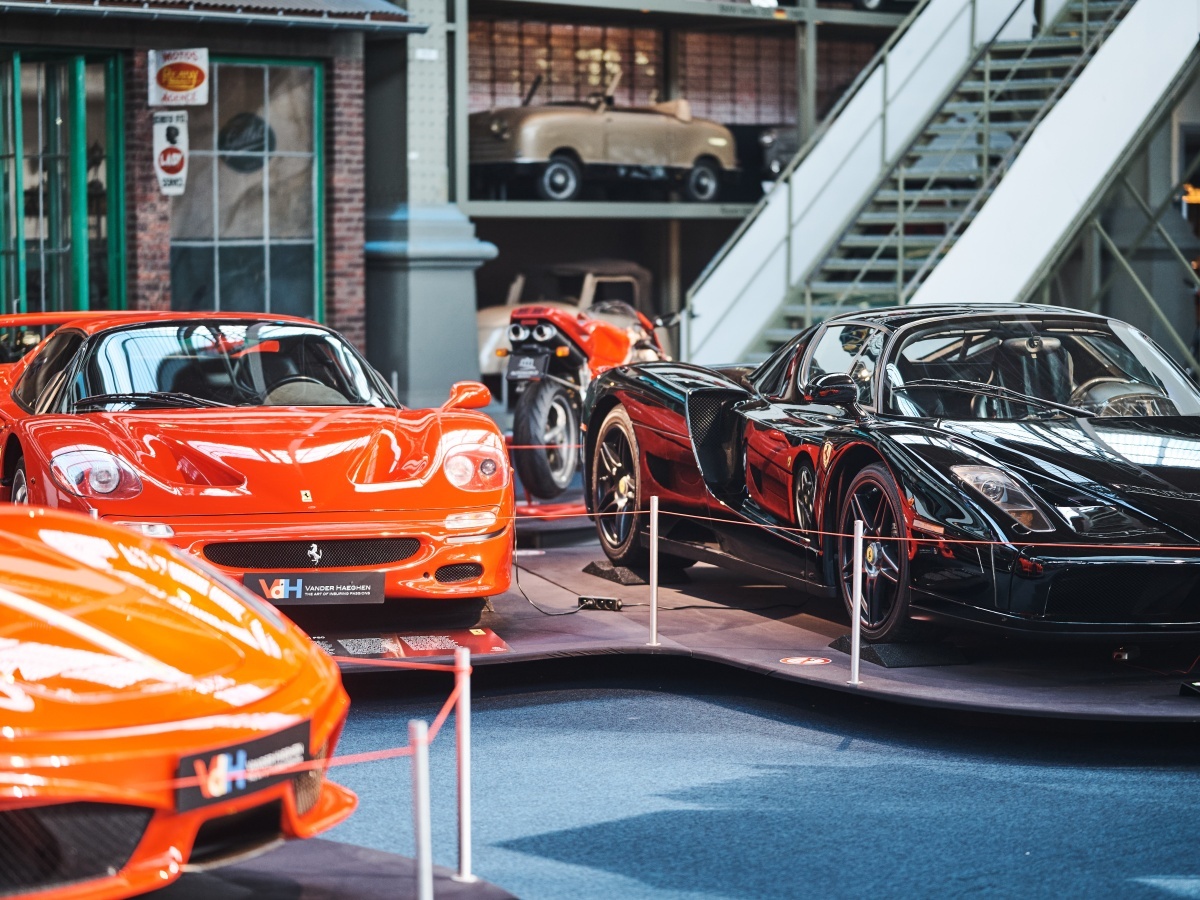
FERRARI Premium selection
As part of the museum’s ongoing evolution and following high public demand, a new space has recently been created, dedicated to modern supercars & youngtimers.
Currently, this area showcases a selection of legendary Ferrari models. What all these Ferraris have in common is that they could only be purchased by pre-selected clients, with factory approval. This high-end selection therefore constitutes an extremely rare collection among Ferrari youngtimers.

TEMPORARY EXHIBITIONS
15 years ago, Autoworld made a decisive choice to innovate: temporary exhibitions became the beating heart of the museum. Since then, they have provided a constant flow of fresh content and surprising themes.
Each year, Autoworld presents two major exhibitions and around five pop-up exhibitions covering a wide range of topics — from iconic brands and legendary models to remarkable trends and design stories.
Thanks to this continuous variety, the museum remains vibrant and up to date, offering car enthusiasts something new to discover with every visit.