

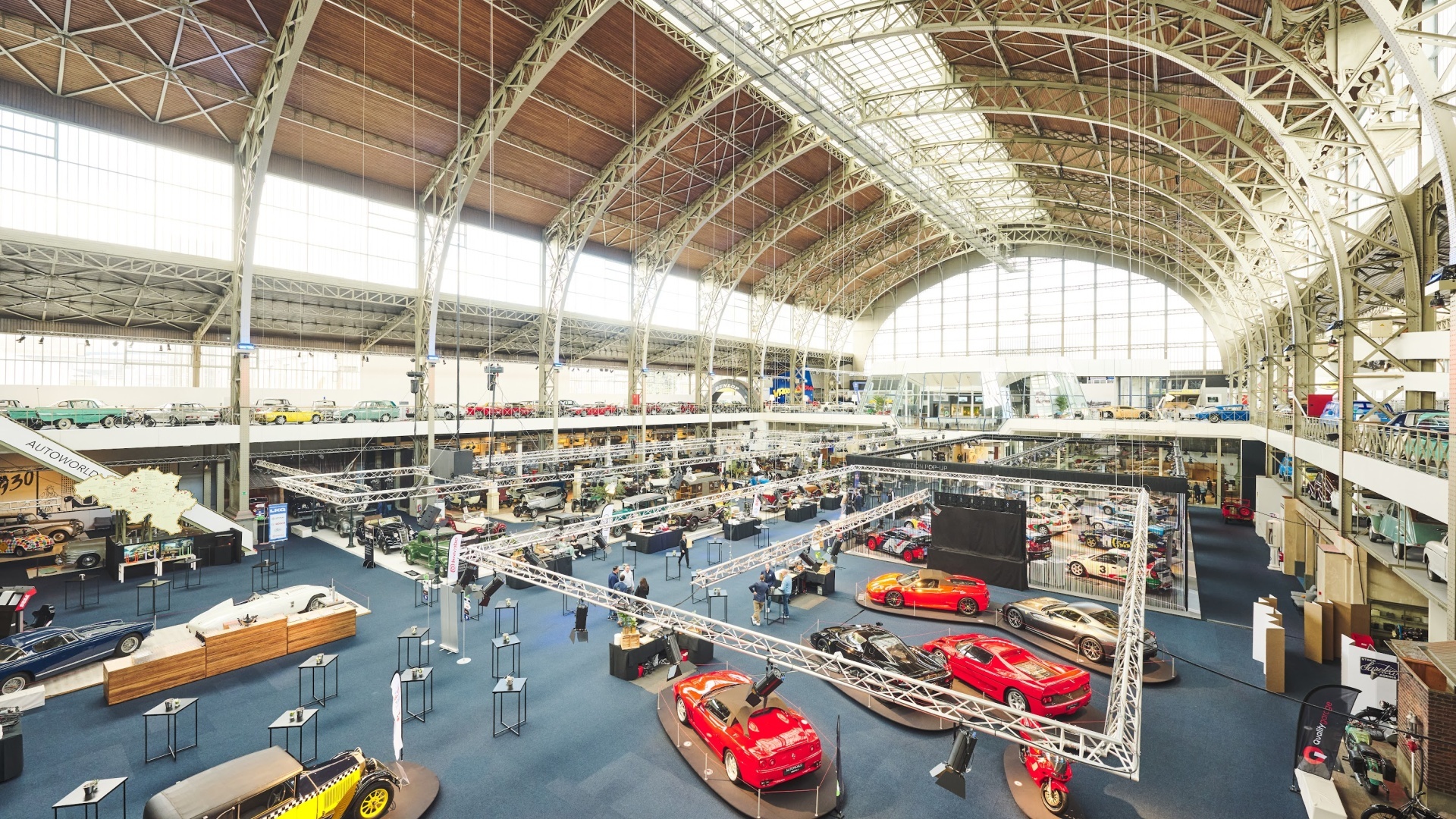

AUTOWORLD, the National Automobile Museum of Belgium
Autoworld Museum Brussels is located in the prestigious Cinquantenaire Palace in Brussels. For nearly 40 years, it has been telling the story of automobiles and motorcycles, from the first pioneers to contemporary supercars, through a collection of over 300 vehicles.
The museum combines a permanent collection with temporary exhibitions, offering a dynamic experience that highlights both Belgian and international automotive heritage.

The Opening in 1986
In the early 1980s, Autoworld came into being thanks to the long-standing commitment and perseverance of King Albert II, Minister Louis Olivier (former Minister of Public Works and former Vice-President of Autoworld), and President Herman De Croo (who led the Belgian Transport Department for eight years and remained President of Autoworld until 2020).
Their involvement laid the foundation for the creation of the museum, which opened its doors to the public on September 26, 1986, as a remarkable institution dedicated to the history of the automobile. Their joint efforts led to the establishment of a unique place where Belgian automotive history comes to life.

The Mahy Collection
This is the impressive and carefully preserved automobile collection of the Mahy family, one of the largest in the world, which contributed to the creation of Autoworld.
The founder Ghislain Mahy (1907–1999), passionate about mechanics from a young age, personally restored dozens of cars throughout his life. Together with his sons Hans and Ivan, he built an exceptional collection of nearly 1,000 vehicles, including many Belgian brands such as Minerva, Germain, FN, Imperia, Fondu, Vivinus, Nagant, Belga-Rise, and Miesse.
When Autoworld Museum was established in 1986, no fewer than 200 vehicles from the Mahy Collection were displayed there.
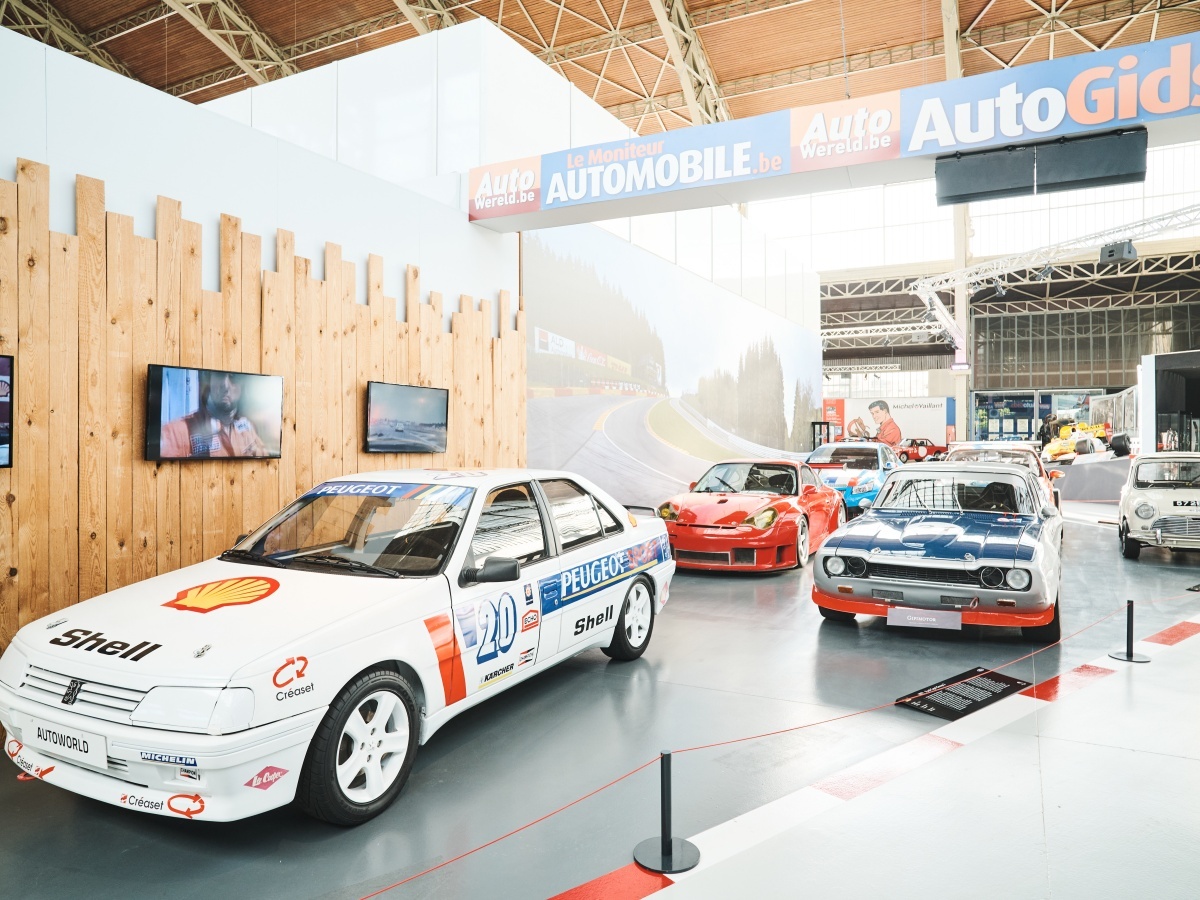
A NEW DYNAMIC
In recent years, and especially since 2010, the museum has undergone numerous transformations and lasting improvements, with the creation of new zones such as :
Sport and Competition (2012)
Belgium at Autoworld (2014)
Modern and Authentic Workshops (2015)
Media Room (2017)
Salon 1919 (2019)
Design Story (2021)
Royal Cars (2024)
Each year, two major temporary exhibitions featuring around fifty vehicles are held, attracting a wide audience.
Throughout the year, numerous small pop-up exhibitions and automotive-related events also take place, delighting the museum’s loyal audience.

The Future
Thanks in particular to special relationships with the Belgian State and the Building Authority, a new lease agreement was concluded based on government decisions and a Royal Decree, securing the building’s rental until 2041.
This extension gives Autoworld the opportunity to safeguard the museum’s future and to elevate the overall visitor experience to a higher level. Behind the scenes, the team is actively preparing a major renovation. More information on this will be shared soon.

THE DREAM OF KING LEOPOLD II
King Leopold II (1835–1909) had an ambitious vision for Brussels. He aimed to transform the capital into a modern, livable, and prestigious city, capable of rivaling the major European metropolises. Under his reign, Brussels underwent a series of ambitious urban projects, inspired by the Parisian cityscape and characterized by monumental avenues, elegant squares, and imposing buildings.
For Leopold II, architecture and urban planning were ways to demonstrate Belgium’s prosperity and power. His dream was to make Brussels a city reflecting both royal dignity and the country’s industrial and artistic progress.

CINQUANTENAIRE PARK – A MONUMENTAL ACHIEVEMENT
One of the most emblematic expressions of this vision is Cinquantenaire Park, where Autoworld is located today. In 1880, on the occasion of the 50th anniversary of Belgian independence, Leopold II commissioned architect Gédéon Bordiau to design a vast park celebrating this national milestone.
Bordiau envisioned a monumental ensemble, featuring an imposing triumphal arch and columned galleries, intended to symbolize the prestige the king wished to bestow upon Brussels.

In preparation for the 1888 World’s Fair, Bordiau built an impressive glass and steel hall behind the triumphal arch, designed to showcase Belgian craftsmanship in these fields. The roof structure spanned 48 meters, a remarkable technical achievement for the time.
Later, Leopold II had the hall divided into two symmetrical wings, giving rise to the Esplanade, a vast open space that highlighted the view of the triumphal arch and Avenue de Tervuren. In this way, Cinquantenaire Park became a striking example of Belgian ambition and innovation, and the impressive historic site of which Autoworld is now a part.